
Closets
How to Organize a Walk-In Closet
Learn how to organize a walk-in closet: assess your lifestyle first, categorize by type, place items for accessibility, then add hangers, bins, and labels last.
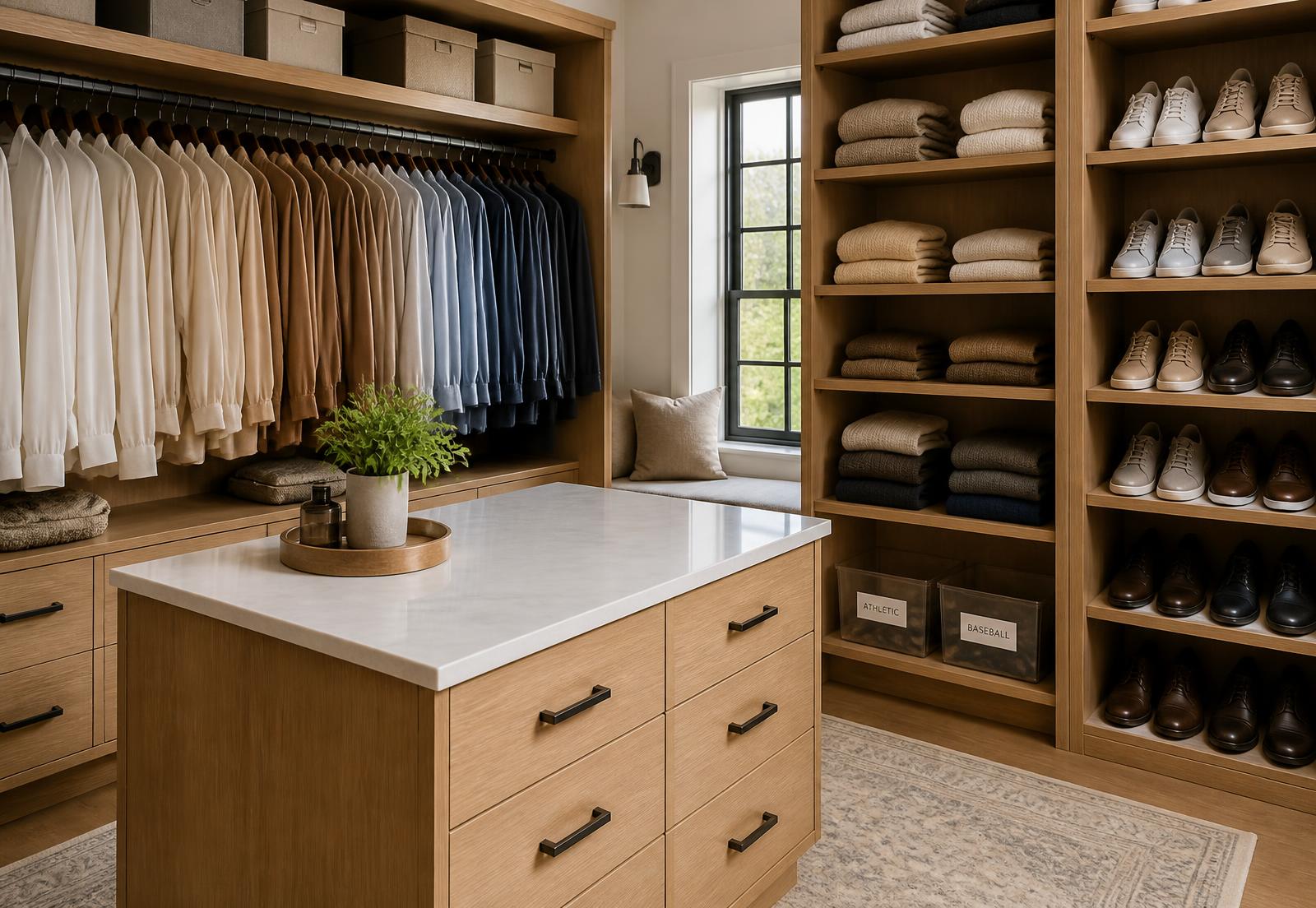
A walk-in closet gets organized in a specific order: understand how you actually get dressed, map out the hanging space you have, sort everything into categories, place those categories where you'll actually use them, and only then bring in hangers, bins, and labels. Most walk-in closets that fall apart within a few months skipped straight to the bins.
Here's how to work through it properly, in the order that actually holds up.
Where do you start when organizing a walk-in closet?
Start with how you get dressed, not with what's already on the rod. A closet system built around a template instead of your real week is the most common reason organizing doesn't stick. Before you touch a single hanger, get honest answers to a few questions: what you actually wear in a typical week versus what's just taking up space, whether you lay clothes out the night before or decide in the morning, where piles tend to form and why, what's frustrating about the closet as it exists right now, and whether there are items you never wear but wish you did.
Your answers should also settle one tension that shapes everything else: how much you want the closet to prioritize aesthetics and quick access versus protecting higher-value pieces. Both are valid. They just lead to different systems.
Once you know how you live in the space, look at the physical architecture. Hanging space splits into two zones: long-hang for coats, dresses, and robes, and short-hang for shirts, folded-over pants, and jackets. Mapping those zones before you sort tells you where each category can actually live.
How should you categorize items in a walk-in closet?
Sort by type or by occasion, whichever matches how you get dressed. Some closets work best divided into Tops, Pants, Skirts, Dresses, Suits, Heels, and Tennis Shoes. Others make more sense split by occasion, like Casual Clothing versus Work Wardrobe. There's no universal right answer. It depends on you, your lifestyle, and the shape of your closet.
Whichever structure you choose, resist the urge to cram every category into the space you have. A closet that's stuffed to capacity is a closet that won't stay organized, no matter how good the system underneath it is. If the closet is overflowing once everything is sorted, that's the moment to edit the wardrobe, move seasonal pieces to another closet, or relocate special-occasion wear somewhere it doesn't compete for daily real estate.
Where should items go for everyday accessibility?
Put what you wear most often at eye level, and keep it there. Nothing you reach for daily should be buried on a bottom shelf or require a step stool.
Shoes follow a similar logic, with three zones from bottom to top: tennis shoes and everyday sneakers near the floor, everyday shoes on middle shelves or racks, and formal and occasion shoes higher up, worn less often. If you have leather shoes worth protecting, cedar shoe trees inserted right after wearing absorb moisture and prevent the toe box from creasing. Tall boots hold their shape longer with rigid boot shapers inside the shaft.
Should a walk-in closet be organized by color?
Yes, but only after it's organized by category. Color-coding an entire closet from end to end looks striking for a photo and falls apart within a week, because it ignores how you actually search for things. Zone first by type or occasion, then arrange by color inside each zone.
The order that reads most naturally, whether you're organizing a hanging rod or a folded shelf, runs like this: white, cream, tan, light pink, darker pink, red, light orange, orange, light yellow, yellow, pale green, green, light blue, blue, lavender, purple, brown, gray, black. Applied inside a category instead of across the whole closet, it does what it's supposed to do: help you find things faster, not just look good.
What's the right way to hang and fold clothes?
Match your hangers. A closet with five different hanger styles reads as cluttered no matter how well everything else is sorted, and uniform hangers protect the investment you've made in your wardrobe. The exceptions are purposeful: silk padded hangers for delicate special-occasion dresses, and broad, contoured hardwood hangers between 1.5 and 2 inches wide for tailored suits and heavy coats, which need real support at the shoulder.
Get rid of dry-cleaning plastic the moment clothes come home. It traps moisture, off-gasses chemicals, and yellows fabric over time. Higher-end pieces do better in breathable, acid-free garment covers.
Not everything belongs on a hanger. Cashmere, heavy knits, basic sweaters, tank tops, t-shirts, workout pants, swimsuits, and heavily beaded or bias-cut gowns should be folded instead. Left hanging, gravity stretches the shoulder seams and distorts the shape permanently.
How do you protect delicate or high-value pieces in a walk-in closet?
Keep direct light and heat away from anything that can fade or degrade. If your walk-in has a window, drapes or UV-filtering treatment protect silks, leathers, suedes, and wools from cumulative damage. Warm-spectrum LED lighting, in the 2700 to 3000 Kelvin range, paired with a motion sensor or timer, keeps light exposure limited to the moments you're actually in the closet.
For genuinely irreplaceable pieces, like rare leathers, vintage silks, or couture, the safest spots are inside drawers, storage boxes, solid cabinet doors, UV-tinted glass, or breathable cotton garment covers rather than in the open.
Heavy handbags deserve the same care. Structured bags hold their shape longer resting flat and upright on a shelf than hung by their handles, which lets gravity slowly distort the leather. Stuffing them with acid-free tissue, never newspaper, keeps the shape intact between wears.
What bins and containers actually work in a walk-in closet?
Choose clear or opaque based on what you want to see, not just what looks nice. Clear bins work well for items you want to remember to wear, since you can spot them at a glance. Opaque bins in wicker, leather, cloth, or wood are better for anything that looks messy or gets used hard, like flip-flops or worn sneakers, where visual clutter isn't the point.
Awkward-to-fold items do best contained individually first, in a mesh bag for swimsuits or a sweater bag for knits, then stored in a bin, drawer, or shelf. Save lids for bins you open rarely; on anything you access often, a lid is just one more step between you and getting dressed. Whatever you choose, label it clearly and consistently. A system only works if you can find things without opening every container to check.
One more thing worth saying plainly: buy the containers last, not first. Bins purchased before a space is measured rarely fit the shelf, the item, or the routine they're meant to serve. More on why that order matters.
Is it worth hiring a professional to organize a walk-in closet?
If the project keeps getting pushed to next weekend, most likely yes. A walk-in closet is one of the few spaces in a home where the sorting, the systems, and the styling all have to work together, and it's easy to get eighty percent of the way there and lose momentum on the last, most detailed steps.
That's the gap a professional closet organizer closes: someone who measures before recommending products, edits alongside you instead of dictating, and finishes the styling instead of stopping once things are merely functional. At Closet Coach & Company, projects are scoped by size rather than guesswork. A single trouble area or small closet typically fits into one five-hour session. A medium closet, a his-and-hers closet with drawers, or a project spanning multiple spaces calls for a multi-session package with product recommendations and installation built in. See how the packages break down and explore the closet transformation process to pick the level of support that matches your project.
Frequently Asked Questions
How long does it take to organize a walk-in closet?
It depends on the size and complexity of the space, not a fixed formula. A small closet or single trouble area often fits into a single five-hour session, while a larger closet with drawers, multiple zones, or a his-and-hers setup usually needs several sessions to sort, source products, and finish the styling.
Do I need to buy bins or hangers before I start organizing?
No. Measuring the space and sorting what you own comes first. Buying containers before you know what needs to fit inside them is the most common reason people end up making returns.
Can I organize a walk-in closet without getting rid of anything?
Yes. Purging is optional, not a requirement. A closet can be fully sorted, categorized, and contained using only what you already own. Editing the wardrobe becomes necessary only if the space is genuinely overflowing once everything has a category.
What's the most common mistake people make organizing a walk-in closet themselves?
Buying storage products before sorting, and color-coding before zoning. Both create a closet that photographs well and stops working within a week, because neither one accounts for how the space gets used every morning.
Make it easy to book
Pick a time. Pay online. Breathe easier.
No sales call, no estimate visit, no pressure. Choose the package that fits your project, select your date, and pay when you book. That's it.
Packages from $500 · Five-hour sessions · Serving Nashville, Davidson County, and Williamson County, TN