
ADHD
How to Organize Your Closet When You Have ADHD
Closets for ADHD brains need less willpower and more visual cues. These small systems make putting things back the obvious choice.
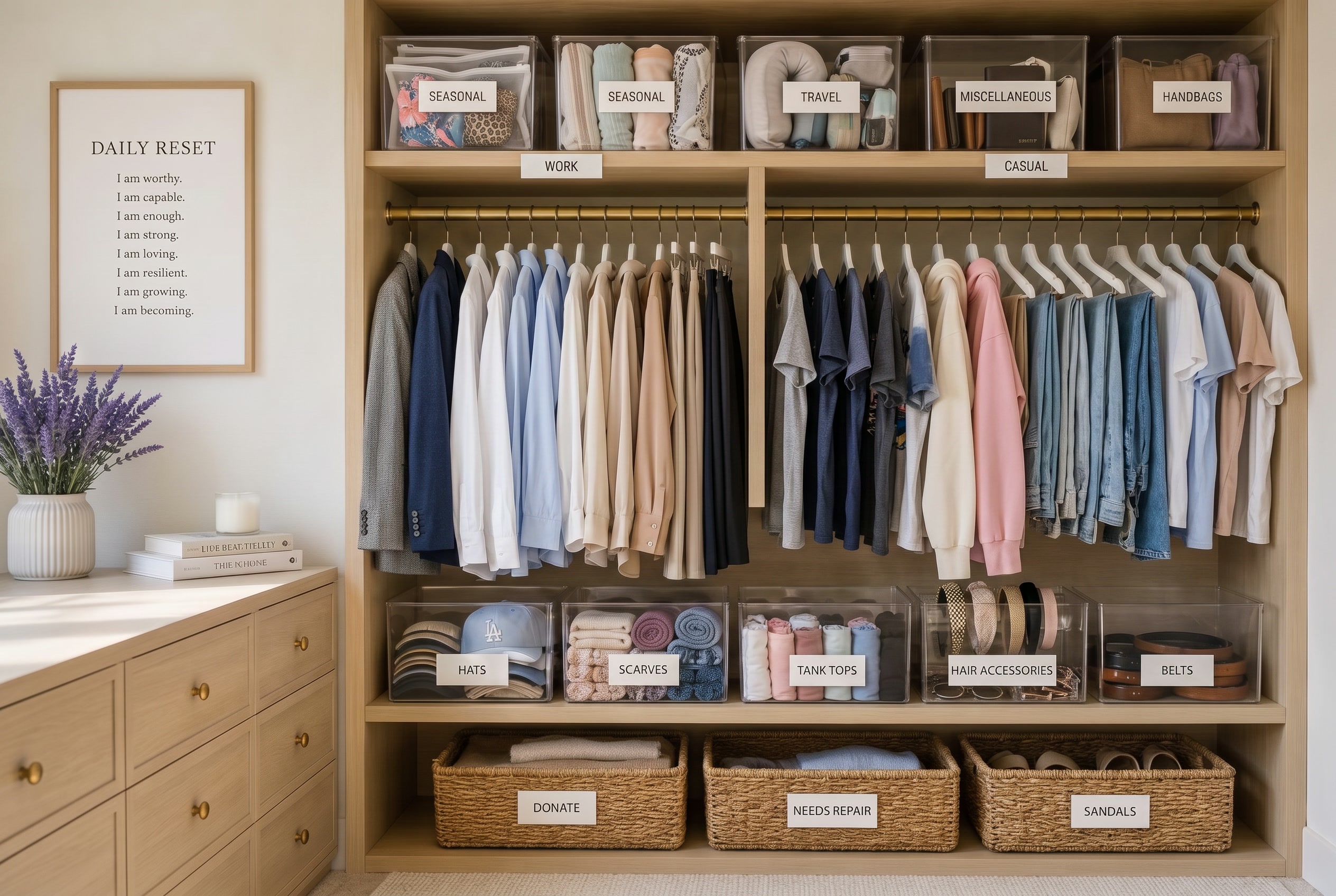
If you have ADHD, the hardest part of a closet isn't the first big sort, it's the daily maintenance. A closet that looks beautiful but requires a lot of invisible decision-making will fall apart fast. The goal is to make the right place for each item so obvious that you don't have to think.
1. Use clear containers with big, simple labels. When you can't see what's inside, out of sight becomes out of mind. Clear bins and readable labels turn 'put away' into a one-second decision. Skip fancy fonts; block letters work best.
2. Color-code by outfit, not by rainbow. As much as we love the full rainbow sort, it is beautiful but harder to maintain for the ADHD brain. Instead, group by the way you get dressed: work tops together, casual tops together, then sort by color inside each small group. Fewer decisions every morning. Keep the categories broad to minimize decision fatigue.
3. Keep a visible donation basket inside the closet. ADHD brains hold onto guilt about clothes that no longer fit or feel right. A permanent donation basket gives those items a labeled exit route, so they don't boomerang back onto the rod. 4. Keep a needs repair basket inside the closet. If you have a pant hem that fell out, a seam that ripped or something that needs to be fixed, keep them all together, so that when you get around to it you don't face decision paralysis thinking there was one item you forgot.
5. Match hangers to the same style and color. Mixed hangers create visual noise and make the closet feel messier than it is. One uniform hanger style reduces chaos and makes every item feel like it belongs.
6. Make the reset two minutes or less. The best closet system is one you can restore on a low-energy day. That means no stacking, no folding precision, and no complicated arrangement. A system you can fix in two minutes is a system you'll keep.
A closet organized for ADHD doesn't ask you to be someone you're not. It removes the friction so that tidying feels like the easier option. If you want help building these systems in your own Nashville closet, we bring the bins, the labels, and the plan.
Frequently Asked Questions
Your Questions, Answered
What Is a Realistic First Step When a Two-Minute Closet Reset Still Feels Overwhelming?
Choose one category and bring everything in that category together in the same area. Work on one category a day rather than trying to reset the whole closet at once.
How Can I Keep Scarves, Hats, and Accessories Visible Without Making the Closet Feel Cluttered?
Hats can become a wall feature, almost like art. Arrange them in a row or an intentional zigzag pattern to keep the display feeling orderly.
Scarves can be folded neatly in a bin, placed on scarf hangers if you have enough hanging space, or laid neatly in a drawer. Avoid tying them into a ball, which can wrinkle the fabric or distort the scarf.
How Do You Choose Label Size, Wording, and Placement for an Individual Client?
We usually use a standard-size label maker, but larger labels can be ordered for clients with specific visual needs. We discuss whether more specific categories or broader categories will work best for you, including whether fewer, broader categories would make a neurodivergent client's system easier to use.
Labels go where they are easiest to see on the bin. If a larger label is needed, we also consider where it fits best.
How Can the System Stay Consistent When Someone Else Puts Away My Laundry?
That is what labels, bins, and designated storage systems are designed to support. If you have a housekeeper or several people sharing a space, clearly labeled homes for items help everyone put things back in the same place.
What Should I Change if Clothes Keep Landing on the Floor or a Chair Instead of Their Designated Spot?
Create a home for those clothes that is easier to use. For lightly worn or once-worn items, hooks or a separate section can keep them tidy without mixing them with clean clothing. A pullover might work well on a clothing hook or a designated hanger at the end of the closet.
If the closet's location is the obstacle, consider a nearby place where items can be stored neatly, such as a coat closet or accessible dressing-area hooks. There is no single rule book. Look at where things naturally land and choose the closest practical spot to put them away.
Make it easy to book
Pick a time. Pay online. Breathe easier.
No sales call, no estimate visit, no pressure. Choose the package that fits your project, select your date, and pay when you book. That's it.
Packages from $500 · Sessions up to 5 hours · Serving Nashville, Davidson County, and Williamson County, TN